2026 Comprehensive Authority Guide

Bali Rice Terraces: Subak Landscapes & Verified Tours

Objective 2026 field analysis comparing Tegallalang, Jatiluwih UNESCO, Sidemen Valley, and Munduk. Discover real municipal tariffs, verified guided bookings, ancient water engineering, and anti-tourist-trap protocols.

600+ ha Jatiluwih UNESCO Expanse
1,000+ Yrs Subak Hydraulic System
75k IDR Official UNESCO Entry (~$4.80)
5.0★ Score Top Private Day Tour Rating

Key Field Takeaways for 2026 Visitors

  • Choose Jatiluwih for Authenticity: If you seek pristine, tranquil agricultural immersion free from commercial hustle, drive 1.5 hours northwest of Ubud to DTW Jatiluwih. Its 600 hectares of terraced slopes border Mount Batukaru and offer 5 structured trekking trails.
  • Choose Tegallalang for Drama & Convenience: Located just 20 minutes north of central Ubud, Tegallalang provides steep, photogenic ravine terraces, cliffside coffee lounges, and giant jungle swings, but suffers from severe midday congestion between 10:00 AM and 03:00 PM.
  • Sidemen Valley Offers Total Seclusion: Eastern Bali's Sidemen features dramatic Mount Agung vistas, traditional weaving hamlets, and zero municipal entry fees, making it an extraordinary base for hikers and culture seekers.
  • Book Private Day Trips Early: The top-rated GetYourGuide private day excursion (Tour #841262) holds a rare 5.0/5.0 rating across 5,640 reviews and includes door-to-door hotel transport, English-speaking driver-guide, and flexible itinerary customization.
  • Always Carry Cash (IDR): Municipal ticket kiosks, bridge donations (10k–20k IDR), parking attendants (2k–5k IDR), and rural roadside warungs operate strictly on physical cash; credit cards are rarely accepted in the paddy fields.
Head-to-Head

Top 4 Bali Rice Terrace Tours Compared (2026)

Compare verified ratings, inclusions, languages, and pricing across GetYourGuide and Viator.

Feature GYG #1 Bestseller Viator Top Choice UNESCO Heritage Multilingual Private
Tour Name Ubud, Tegallalang & Waterfall Day Tour Ubud & Rice Terraces Private Tour Jatiluwih UNESCO & Water Temples Ubud Waterfalls, Subak & Water Temple
Platform GETYOURGUIDE VIATOR VIATOR GETYOURGUIDE
Rating & Score ★ 5.0 (5,643 reviews) ★ 5.0 (17,623 reviews) ★ 5.0 (2,762 reviews) ★ 5.0 (7,259 reviews)
Duration 8 - 10 hours 10 hours 9 hours 8 - 10 hours
Languages English English English English, French, German
Key Feature Tegallalang Rice Terrace exploration Tegallalang terraced valley visit DTW Jatiluwih UNESCO 600-hectare terrace hike Tegallalang valley walking & photo stops
Price Details From $13.20/person (Private car options from $38) $38.00 total per group (up to 5 people) $39.00/person (All temple & park tickets included) From $19.80/person
Action Book Now → Book Now → Book Now → Book Now →
Live Availability Calendar

Reserve Top-Rated Ubud Rice Terrace & Waterfall Day Tour (GYG #841262)

5.0★ rating across 5,640+ verified traveler reviews. Select your preferred date below for instant voucher confirmation and 24-hour free cancellation.

Regional Spatial Analysis

The Five Major Rice Terrace Regions of Bali

Understanding the geographic topography, altitudinal microclimates, and logistical differences across Bali's primary terraced river valleys.

UNESCO World Heritage Site

1. Jatiluwih Rice Terraces (Tabanan Regency)

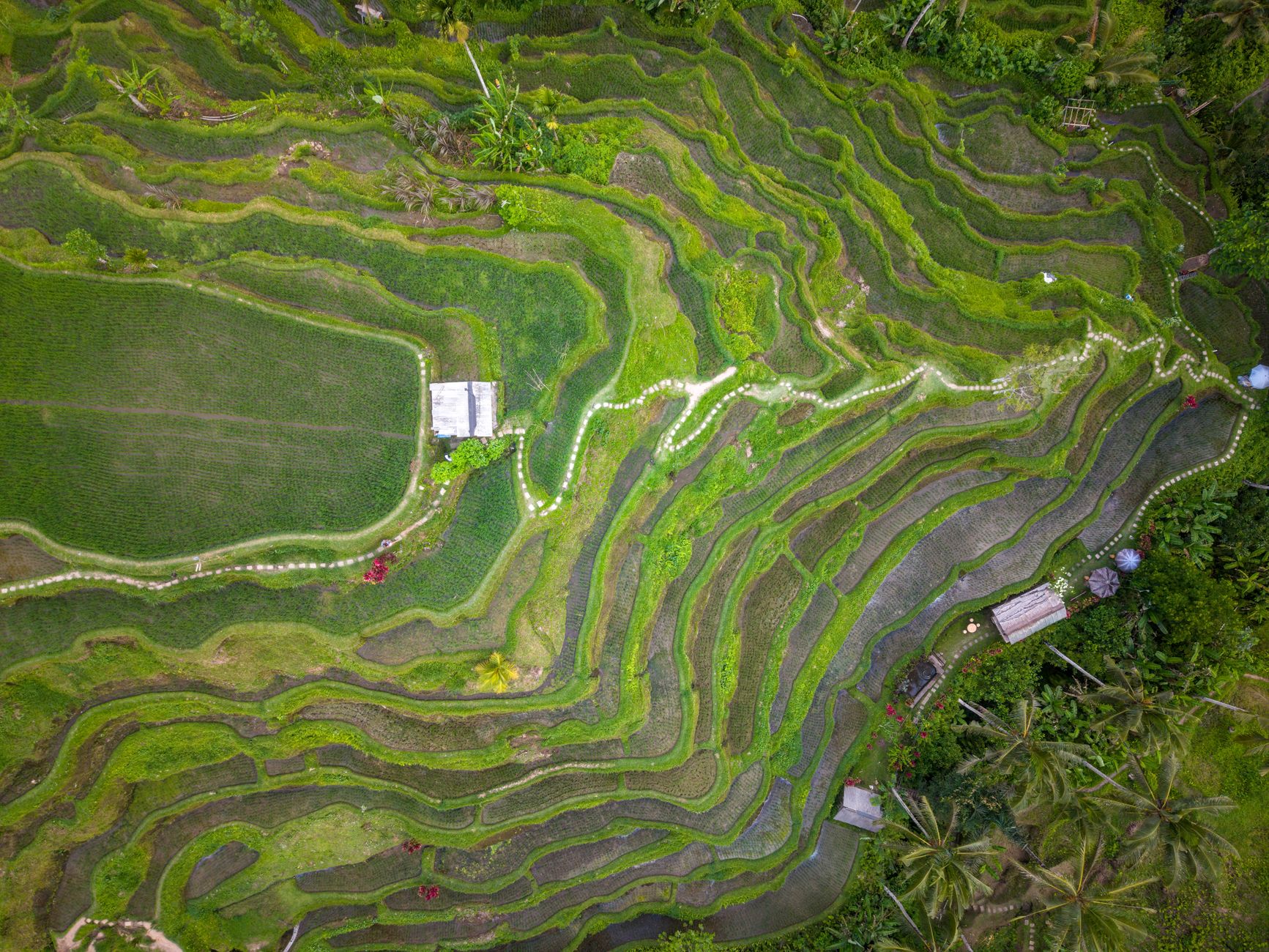
Spanning more than 600 contiguous hectares along the volcanic slopes of Mount Batukaru at an altitude of 700 to 850 meters above sea level, Jatiluwih represents the grandest and most ecologically intact terraced agro-ecosystem in Southeast Asia. Awarded UNESCO Cultural Heritage status in 2012 as the physical core of Bali's Subak system, Jatiluwih cultivates traditional, slow-growing heirloom Balinese red rice (Beras Merah Pari Temon), which takes over 6 months to mature.

Unlike the steep river gorge of Tegallalang, Jatiluwih unfolds in expansive, sweeping horizontal contours across rolling hillsides. Visitors can explore five color-coded walking trails ranging from an easy 1.5 km paved loop to a demanding 5.5 km trek crossing bamboo bridges, mountain streams, and organic farming hamlets.

Fee: 75,000 IDR (~$4.80) Trails: 5 Marked Routes Drive from Ubud: ~1.5 Hours
Complete Jatiluwih Field Guide →
Expansive rolling green terraces of Jatiluwih UNESCO heritage site in Tabanan Bali
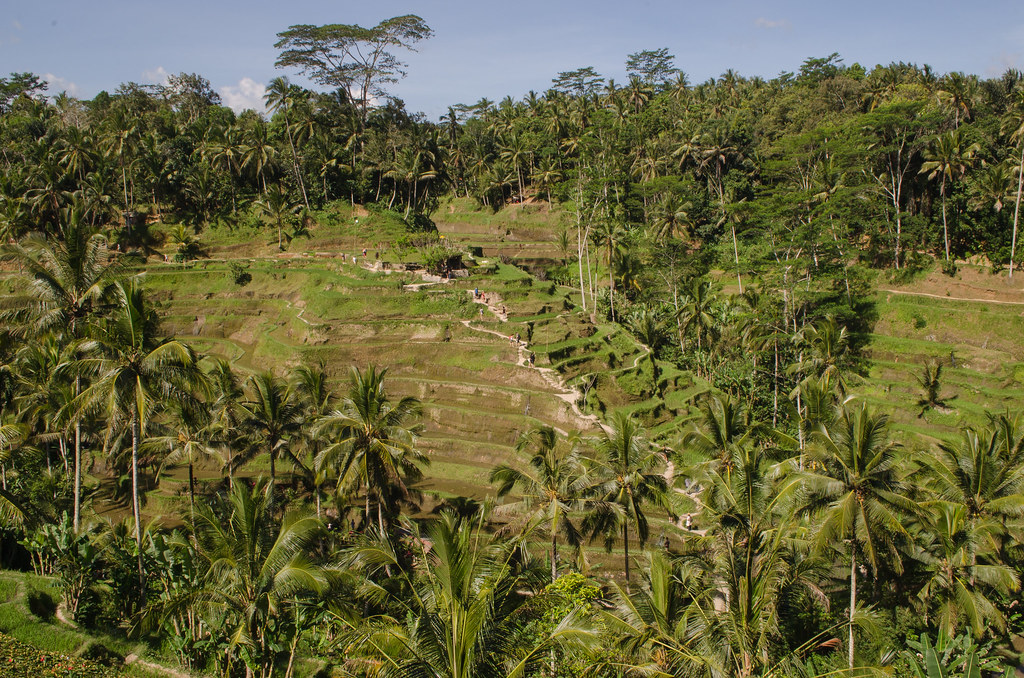
Steep terraced ravine of Tegallalang near Ubud with morning sunbeams through palms
Scenic Vertical Ravine

2. Tegallalang Rice Terraces (Gianyar Regency)

Carved into a narrow, dramatic river gorge along Jalan Raya Tegallalang roughly 10 kilometers north of Ubud Palace, Tegallalang is Bali's most photographed agricultural attraction. Its stepped amphitheater design allows water channeled from higher mountain streams to cascade vertically across dozens of narrow ledges fringed with swaying coconut palms.

Tegallalang is celebrated for high-adrenaline valley swings, tandem skybikes, and panoramic open-air cafes overlooking the gorge. However, its close proximity to southern tourist hubs generates heavy daytime crowds. To experience the valley in peaceful solitude with mystical morning sun rays piercing the palm fronds, you must arrive between 06:15 AM and 07:30 AM.

Fee: 25,000 IDR (~$1.60) Swings: 150k–300k IDR Drive from Ubud: ~25 Minutes
Complete Tegallalang Guide & Swings →
Pristine Eastern Foothills

3. Sidemen Valley (Karangasem Regency)

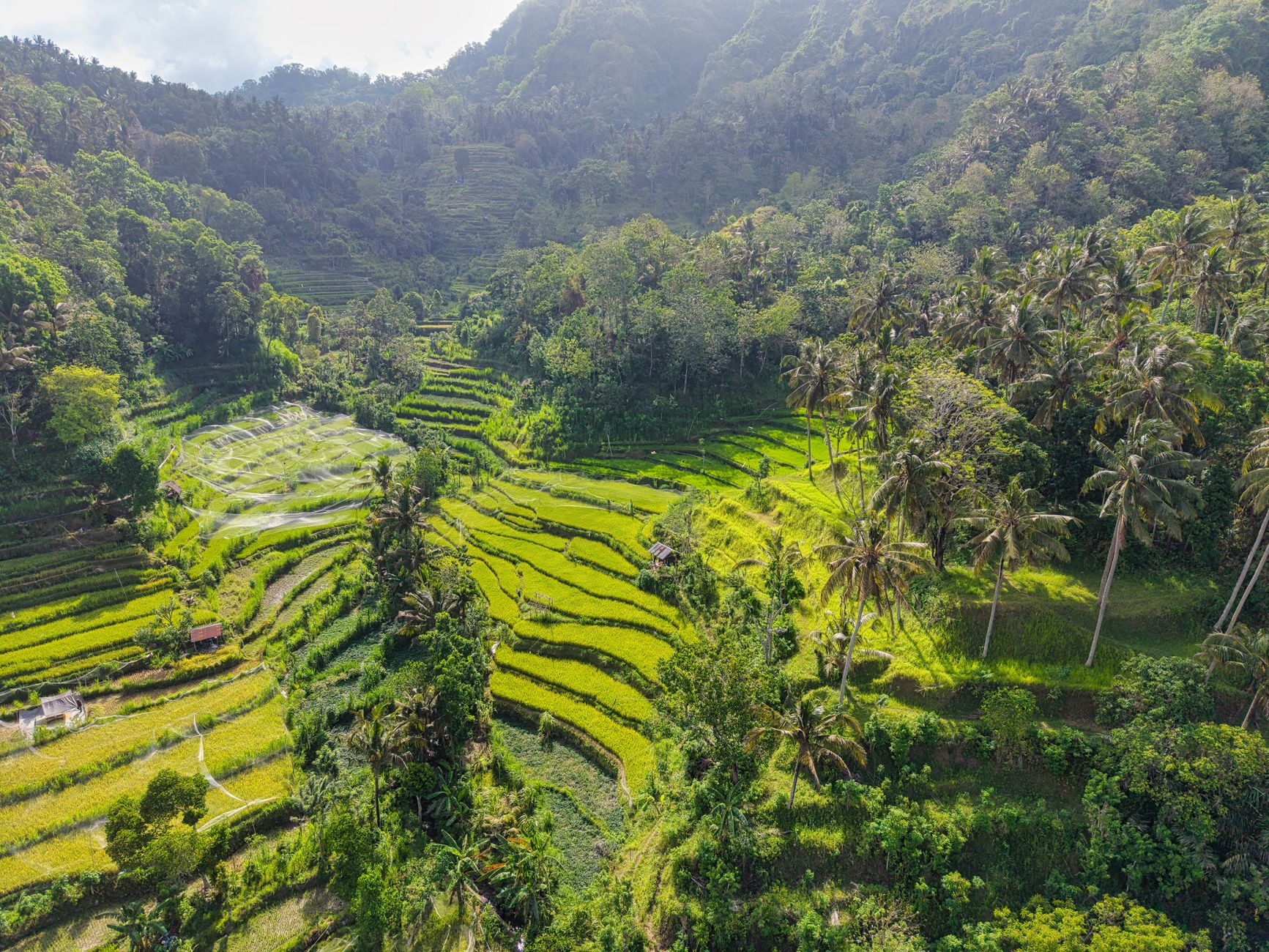
Resting beneath the towering southern flank of Mount Agung, Sidemen Valley offers a captivating glimpse into old Bali. Fed by the swift-flowing Unda River, this emerald agricultural amphitheater features working paddies bordered by chili, cocoa, and banana groves. Sidemen has vigorously avoided mass commercialization; there are no ticket booths, selfie platforms, or tour buses clogging the roads.

Visitors can trek unpaved farmer pathways with local village guides, witness exquisite Endek and Songket handloom textile weaving in Banjar Tabola, and stay in breathtaking open-air bamboo eco-villas perched right over active rice terraces.

Fee: Free / Village Donation Highlight: Mount Agung Panoramas Drive from Ubud: ~1.2 Hours
Complete Sidemen Valley Guide →
Lush Sidemen Valley rice terraces framed by the volcanic peak of Mount Agung in Bali
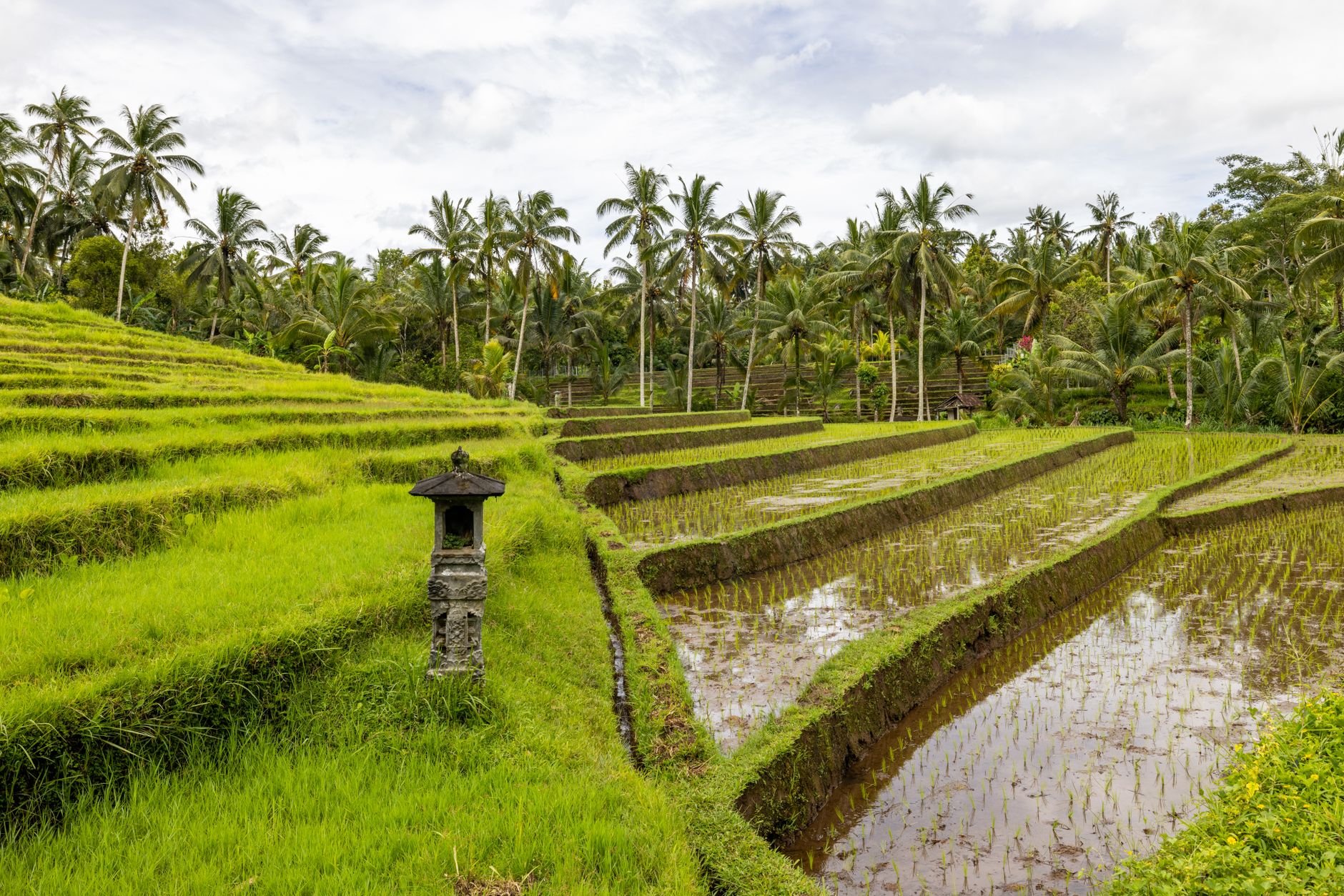
Tranquil walking path through the Kajeng rice fields directly behind central Ubud Walking Escape in Ubud

4. Ubud Kajeng & Sweet Orange Trail

Beginning right off busy Jalan Raya Ubud, Jalan Kajeng leads along a charming stone-inscribed lane into a peaceful agricultural walking loop. The route connects with the Sweet Orange Trail, winding through tranquil organic rice paddies without motor vehicle traffic. Ideal for morning walks, sunset strolls, and relaxing organic warung lunches.

View Kajeng Trail Map & Directions →
Misty high-elevation terraced hillsides and forest valleys in Munduk northern Bali Highland Cool Climate

5. Munduk Highlands & Valley Ridges

Perched at elevations exceeding 1,000 meters in Buleleng Regency, Munduk features steep hillside paddies intertwined with clove, cocoa, and vanilla plantations. Cool mountain breezes, frequent afternoon mists, and connections to the famous Munduk waterfall trekking trail make this a northern sanctuary for eco-hikers.

Explore Munduk Trails & Waterfalls →
Living Cultural Heritage

The Subak System: Over 1,000 Years of Hydraulic Wisdom

How ancient Balinese water temples and democratic farmer cooperatives engineered Southeast Asia's most resilient agro-ecosystem.

The breathtaking beauty of Bali's stepped rice terraces is not an accident of nature, nor the creation of modern landscaping. It is the tangible manifestation of Subak, a self-governing, egalitarian socio-religious water management institution documented in Balinese royal stone inscriptions dating back to 882 CE (the Sukawana and Trunyan copper charters).

At its core, Subak embodies the Balinese philosophical framework of Tri Hita Karana ("The Three Causes of Well-being"), which asserts that spiritual peace and communal harmony can only be achieved when three realms remain in perfect equilibrium:

  • Parahyangan: Harmony between humanity and the Divine, expressed through rituals at sacred water temples (Pura Ulun Danu) and field shrines (Ulun Swi).
  • Pawongan: Harmony among human beings, manifested in the democratic, egalitarian voting structure where every farmer—regardless of landholding size or caste—holds an equal vote in water allocation and canal maintenance duties.
  • Palemahan: Harmony between humanity and nature, maintained through synchronized planting cycles, biological pest control, organic fertilization, and strict prohibitions against water hoarding.

Gravity-Flow Hydraulic Engineering

Balinese volcanic soil is extraordinarily fertile, but the island's terrain is characterized by deeply incised ravines and fractured volcanic ridges. To irrigate vertical terraces without electric pumps, ancient Balinese engineers developed an intricate network of gravity-flow channels: weirs (empelan), bamboo aqueducts, and hand-carved stone tunnels (aungan) stretching for kilometers through solid volcanic tuff cliffs.

At the apex of each terrace block stands a distribution structure called a Temuku. This hand-carved wooden or stone weir divides the main water stream into precisely proportioned feeder channels based on the surface area of each sub-block. The system ensures that downstream farmers receive their exact water allocation before water flows into lower tiers. In times of drought, water rotation schedules (giliran) are enacted through unanimous cooperative council decisions.

Experience Living Subak with a Local Agricultural Guide

Walking the terraces alongside a licensed Balinese heritage guide illuminates the spiritual meanings behind field offerings, water division stone gates, and heirloom red rice harvesting.

Book 5.0★ Rated Guided Subak Tour →

The Ecological Genius of Synchronized Fallowing

Modern industrial agriculture relies heavily on chemical pesticides, but the ancient Subak system controls insect infestations and fungal blights through synchronized cropping cycles. Under the guidance of water temple high priests at Pura Ulun Danu Batur and Pura Ulun Danu Bratan, dozens of contiguous subaks coordinate their planting and harvesting dates simultaneously.

When an entire valley harvests at the same time and subsequently floods all terraces simultaneously, the insect pests (such as the brown planthopper) are starved of food across thousands of hectares, effectively breaking pest life cycles without chemical intervention. Ducks are then herded into the flooded paddies to forage on weeds and snails while naturally fertilizing the volcanic soil.
Seasonal Field Guide

The Balinese Rice Farming Cycle: Month-by-Month

What the terraces look like throughout the year and how to time your trip for mirror reflections, vivid emerald greenery, or golden harvests.

Months Farming Stage Visual Appearance Photography & Drone Conditions Crowd & Weather
Dec – Feb Tilling & Flooding Terraces filled with crystal-clear water; glassy mirror effect reflecting sunrise clouds. Exceptional for reflection photography; dramatic overcast skies and vibrant contrasts. Wet season; afternoon tropical downpours common. Lower tourist volumes.
Mar – May Active Vegetative Growth Intense, electric emerald green paddies growing rapidly; lush tropical backdrop. The absolute prime visual window for classic Bali postcards and lush video footage. Transition to dry season; clear sunny mornings and pleasant afternoon breezes.
Jun – Aug Maturation & Golden Sheaves Rice stalks turn amber-yellow; heavy grain panicles bending gracefully in the wind. Warm golden tones; incredible sunrise light filtering through golden fields. Peak dry season; blue skies, cool mornings, high international tourist volume.
Sep – Nov Harvest & Re-planting Farmers actively cutting sheaves, threshing grain, burning stubble, and re-flooding. Dynamic human interest photography; portraits of traditional agricultural labor. Warm temperatures, low humidity, moderate tourist traffic across all regions.
Detailed Climate & Monthly Guide →

2026 Red Flags, Scams & What to Avoid

Proving editorial independence is our highest priority. To ensure you have an exceptional trip and avoid tourist traps, keep these ground-truth field realities in mind:

  • ✕
    Tegallalang Bridge "Donation" Extortion: As you descend into the deep ravine of Tegallalang, you will encounter multiple wooden shacks with aggressive hand-lettered signs demanding "Donations to pass" (often 10,000 to 20,000 IDR). These are private farmers charging fees to cross their land plots. Legally, the official municipal entrance ticket covers the valley, but arguing with local landowners is stressful. Keep several 10,000 IDR banknotes ready in your pocket so you do not expose your entire wallet.
  • ✕
    Fake "Free" Luwak Coffee Plantation Tours: Drivers often offer to stop at a "traditional coffee plantation" near Tegallalang for free tastings. While the flavored teas are free, the famous civet coffee (Kopi Luwak) costs 50,000–100,000 IDR per tiny cup, and the gift shops charge astronomical prices (up to $50 for a small pouch). More critically, many operations keep nocturnal Asian palm civets in cramped battery cages under poor welfare conditions. Decline unsolicited coffee plantation detours unless you have vetted their ethical practices.
  • ✕
    Midday Tour Bus Gridlock in Tegallalang: Between 10:30 AM and 03:00 PM, dozens of 40-passenger tourist coaches navigate the narrow two-lane road in Tegallalang, creating unbearable traffic jams and packing the narrow valley staircases. If visiting Tegallalang, arrive by 07:00 AM or wait until after 04:30 PM. For mid-day touring, choose expansive Jatiluwih instead.
  • ✕
    Unregulated Extreme Swings Without Dual Safety Harnesses: Roadside selfie setups have proliferated across Gianyar. Several cheap setups use frayed ropes and single waist belts. Only use established, insured swing operations (such as Aloha Ubud or Terrace River Pool Swing) that utilize industrial rock-climbing harnesses, steel cables, and trained safety staff.
  • ✕
    Slick Mud & Footwear Hazards: Terrace irrigation channels flood narrow dirt bunds. Walking between rice tiers after a morning shower turns unpaved dirt into slick clay. Never attempt deep terrace trekking in smooth flip-flops; wear sneakers or rugged hiking sandals with reliable tread.
Where to Stay

Scenic Stays & Bamboo Eco-Villas (Bali Terraces & Scenic Eco-Resorts)

Wake up directly overlooking lush morning mist and emerald paddies. Browse real-time availability and verified rates across Booking.com, Agoda, and VRBO.

Direct Answers

Frequently Asked Questions

Definitive answers to common traveler dilemmas regarding Bali's terraced landscapes.

Jatiluwih is vastly superior for authentic culture, serene hiking, and dramatic scale, whereas Tegallalang is better for quick social media photos and swings close to Ubud. Jatiluwih spans over 600 hectares with Mount Batukaru as a backdrop and rarely feels crowded. Tegallalang is a small, steep ravine packed with tourist cafes, loud selfie swings, and roadside vendors. If you have a full day, visit Jatiluwih; if you only have 2 hours between temple visits in Ubud, choose Tegallalang.

Yes, but it requires a long 8 to 9-hour day trip by private car. The driving distance between Tegallalang and Jatiluwih is approximately 45 kilometers through winding highland roads, taking 1.5 to 2 hours of transit time alone. An ideal itinerary begins with sunrise at Tegallalang (06:30 AM), continues to Tirta Empul Holy Water Temple, and arrives at Jatiluwih around 11:30 AM for lunch overlooking the UNESCO expanse.

Official municipal rates are 75,000 IDR (~$4.80 USD) at Jatiluwih and 25,000 IDR (~$1.60 USD) at Tegallalang. Children pay 40,000 IDR at Jatiluwih. Parking fees range from 2,000 to 5,000 IDR. Sidemen Valley charges zero municipal entrance fee, though small donations (10k–20k IDR) are appreciated when crossing private village tracks. Swings and ziplines at Tegallalang cost extra (150,000 to 300,000 IDR).

Riding a scooter to Tegallalang is easy for confident riders (20 minutes on paved roads from Ubud), but riding to Jatiluwih or Munduk involves steep mountain gradients, blind corners, and heavy rain showers that challenge inexperienced drivers. Furthermore, Indonesian traffic police actively fine foreign riders without a valid International Driving Permit (IDP) and motorbike endorsement. For highland trips, hiring a private car with a local driver ($35–$45/day) or booking an all-inclusive guided tour is significantly safer and stress-free.

Yes, recreational drone flights are widely permitted across open fields at Jatiluwih and Sidemen. At Tegallalang, however, some private cafes and swing operators demand an informal "drone landing fee" of 100,000 to 150,000 IDR. Always keep a safe altitude (under 120m), never fly directly over temples during prayer ceremonies, and respect private guest villas.

Verified Bookings

Vetted Guided Day Trips Across Bali's Terraces

Door-to-door hotel transport, 24-hour full refunds, and top-rated English speaking Balinese guides.

Top Rated #1 / 5,640+ Reviews GETYOURGUIDE Ubud: Full-Day Rice Terrace, Monkey Forest & Waterfall From $13.20/person (Private car options from $38)
★ 5.0 (5,643 reviews) • 8 - 10 hours

Ubud: Full-Day Rice Terrace, Monkey Forest & Waterfall

  • Tegallalang Rice Terrace exploration
  • Sacred Monkey Forest sanctuary entry
  • Tegenungan or Tibumana Waterfall visit
Viator All-Time Bestseller / 17,600+ Reviews VIATOR Ubud Private Tour: Rice Terraces, Temples & Waterfalls $38.00 total per group (up to 5 people)
★ 5.0 (17,623 reviews) • 10 hours

Ubud Private Tour: Rice Terraces, Temples & Waterfalls

  • Tegallalang terraced valley visit
  • Tirta Empul Holy Water Temple
  • Tibumana & Kanto Lampo Waterfalls
UNESCO Subak Cultural Tour VIATOR Full-Day Tour to Water Temples and UNESCO Rice Terraces $39.00/person (All temple & park tickets included)
★ 5.0 (2,762 reviews) • 9 hours

Full-Day Tour to Water Temples and UNESCO Rice Terraces

  • DTW Jatiluwih UNESCO 600-hectare terrace hike
  • Pura Ulun Danu Bratan iconic lake temple
  • Tanah Lot sea temple sunset finish
Multilingual Choice / 7,200+ Reviews GETYOURGUIDE Ubud: Waterfalls, Water Temple & Rice Terraces Private Tour From $19.80/person
★ 5.0 (7,259 reviews) • 8 - 10 hours

Ubud: Waterfalls, Water Temple & Rice Terraces Private Tour

  • Tegallalang valley walking & photo stops
  • Tirta Empul water purification blessing
  • Tukad Cepung hidden cave waterfall
Ubud & Jatiluwih Tours ★ 5.0 (5,640+ reviews) • from $28
Check Tours →